
Key Takeaways
- 1Shift AI from passive document generation to active investigation during outages by connecting agents directly to executing code.
- 2Utilize 'runtime evidence' like localized variable states and execution paths for accurate root cause analysis, moving beyond high-level signals.
- 3Implement human-in-the-loop AI for SRE incident management, ensuring safety and governance with strict sandboxing and PII redaction.
- 4Leverage platforms like Lightrun for on-demand dynamic telemetry, allowing AI agents to gather precise data without modifying deployments.
- 5Transition from speculative incident reports to evidence-backed postmortems, leading to precise fixes and improved system reliability.
The Slow Death of the Traditional Postmortem
Every incident response lifecycle eventually concludes with a familiar, high-friction ritual. Engineers gather their notes, scroll through hours of chat history, search for incomplete log statements, and attempt to write a definitive account of what broke. Google’s foundational guide to blameless postmortems set the industry standard for this process, emphasizing continuous learning over finger-pointing.
Yet, executing this manual process is consistently painful. Writing a thorough retrospective takes hours of dedicated engineering time. Because the human brain struggles to reconstruct complex timelines from faulty memories and fragmented dashboard screenshots, these documents are highly prone to cognitive bias.
Most critically, manual investigations often conclude with vague assumptions. When log data is missing, engineers write phrases like "we suspect" or "likely caused by." This failure to definitively prove the root cause means the resulting preventative action items are just educated guesses, leaving the system vulnerable to the exact same failure mode in the future.
Enter the AI Archaeologist, A Flawed First Step
To solve the toil of writing incident reports, the industry has eagerly adopted large language models. Before critiquing this approach, it is important to define how the current generation of tools operates. Modern incident management platforms use LLMs to consume the exhaust of an incident. They ingest ChatOps channels, PagerDuty alerts, and Zoom transcripts, then compile this text into beautifully formatted summaries.
Tools focusing on text generation, like Incident.io's AI analysis features and Rootly's automated reporting, excel at compressing timelines and drafting initial documents. In these models, the LLM acts as an "AI archaeologist." It sifts through the historical artifacts left behind by human operators, but it never actually observes the system failure itself.
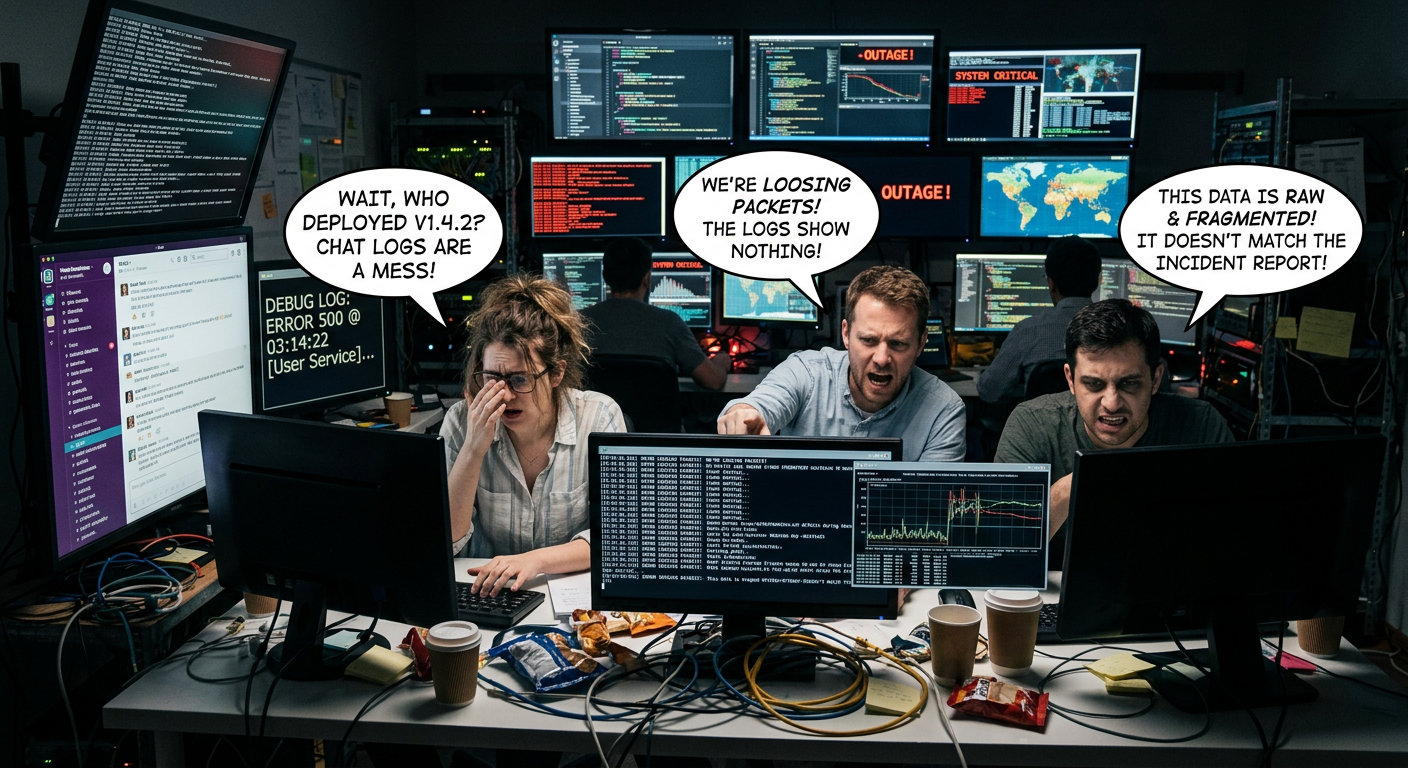
This creates a fundamental structural flaw. The AI is synthesizing second-order data consisting of human panic, incomplete telemetry, and misinterpretations. It evaluates what engineers *thought* was happening, rather than the underlying facts of application behavior.
Garbage In, Well-Written Garbage Out
Synthesizing second-order data results in confident-sounding but potentially inaccurate analysis. An LLM can flawlessly summarize a chat thread where an engineer incorrectly blamed the database, making the incorrect conclusion sound authoritative.
The engineering team at Zalando encountered this exact data quality problem. They utilized language models to analyze thousands of historical documents, turning them into "data goldmines" to identify recurring failure patterns. However, their findings included a critical caveat. They noted that human curation remains crucial to correct for AI hallucinations and surface attribution errors.
When conducting postmortem analysis with AI SRE, relying on historical text means the output is only as trustworthy as the raw chat history. If the telemetry was missing during the incident, the AI cannot confidently discover the root cause after the fact. Automated report writing tools can turn large text volumes into polished reports, often by letting AI populate sections with text and references to original sources.
The Post-Incident Jevons Paradox
This dynamic introduces a fascinating phenomenon. The Jevons paradox for SRE suggests an unexpected outcome of automated reporting. As artificial intelligence drastically lowers the cost and effort of writing mechanical summaries, the overall demand for higher-quality, deeper investigations actually increases.
When the labor of drafting the document drops to near zero, the actual value shifts entirely to the accuracy of the technical findings. There is no evidence to suggest that engineering leadership will expect more detailed, verifiable answers for every minor outage due to the elimination of reporting overhead.
This creates a new bottleneck. The barrier is no longer the time it takes to write the document, but the speed and quality of accessing verifiable evidence. Effective AI SRE incident response automation requires a continuous feed of factual, low-level system data, rather than post-facto summaries.
From Document Scribe to Active Investigator
To solve the evidence bottleneck, we must change our mental model. We need to shift the AI away from being a passive document generator at the end of the incident. Instead, it must become an active investigation partner during the outage.
What we call the "AI Investigator" approach involves connecting autonomous agents directly to the executing code. When an alert fires, the agent does not just read the alert text. It tests hypotheses by querying the application's actual state as it handles traffic. The human engineer transitions from an exhausted firefighter to an investigation strategist. They guide the agent through a truth-seeking process, asking it to fetch specific data points to prove or disprove a theory.
Executing postmortem analysis with AI SRE in this manner changes the entire outcome. The final report is no longer a summary of what people said during the outage. It becomes a cryptographic record of what the application code actually did, backed by irrefutable data.
Fueling the Investigation with Runtime Evidence
Traditional monitoring relies on signals. Engineers look at CPU spikes or error rate dashboards and try to infer the system's internal state. When using an AI agent, feeding it these high-level signals often results in generic, unhelpful advice.
To uncover ground truth, agents need access to "runtime evidence." This consists of dynamic code-level context captured during the exact moment of failure, including localized variable states, method arguments, and execution paths. Unlike traditional logging, which requires engineers to guess what might break and redeploy code to print it, Runtime Instrumentation allows data to be extracted on demand.
Lightrun provides this exact capability via Dynamic Telemetry. Without modifying deployments or restarting services, Lightrun safely inserts instrumentation directly into the application space. By utilizing an AI SRE agent architecture backed by the Model Context Protocol (MCP), autonomous agents can instruct Lightrun to pull exact data points needed to validate an error.
The Old Way: A Guesswork-Filled Assessment
To illustrate the contrast, consider a traditional root cause analysis. Because the team lacked debug-level logs for a specific microservice, the resulting text relies heavily on speculative phrasing.
The following code block shows an excerpt from a traditional incident report highlighting such guesswork. __CODE_BLOCK_0__ This is not a resolution, it is a statement of intent to investigate further. A postmortem analysis with AI SRE would merely summarize this guesswork if it only had access to this text.

The New Way: Direct Validation
By contrast, an AI agent equipped with Lightrun can validate the error as it happens. The following Node.js snippet demonstrates the application code being investigated. The inline comments show where the AI agent, via an IDE Plugin or CLI integration, automatically places Lightrun actions to gather proof.
1// Application Code: billing-service.js
2// Lightrun agent initialization (required at startup)
3require('lightrun/agent').start({
4    lightrunSecret: process.env.LIGHTRUN_KEY,
5    company: 'example-company'
6});
7
8async function processPayment(userContext, paymentDetails) {
9    // Lightrun Snapshot placed here by AI.
10    // Captures the exact state of 'userContext', confirming if it is null or malformed.
11
12    if (!userContext.isActive) {
13        throw new Error("Inactive user");
14    }
15
16    const receipt = await stripe.charge(paymentDetails);
17
18    // Lightrun Dynamic Log placed here by AI.
19    // "Emitting receipt {receipt.id} for user {userContext.id} with status {receipt.status}"
20
21    return receipt;
22}
In this scenario, the agent detects the rising error rate. It formulats a hypothesis about the userContext object. It automatically places a Lightrun Snapshot at the top of the function. Within milliseconds, the snapshot captures the full stack trace and variable tree, proving definitively that userContext is indeed null. The postmortem is automatically generated based on this verified Runtime Context, eliminating all speculation.
Ensuring Safety and Enterprise Governance
Granting artificial intelligence the ability to interact with live environments naturally raises valid security concerns. An autonomous agent cannot be permitted to execute arbitrary scripts, pause system threads, or leak sensitive customer information.
This is why a strategy focused on human-in-the-loop AI for SRE incident management is the most secure path forward. The agent acts as an incredibly fast assistant, but the safety guarantees must be enforced by the underlying instrumentation platform, not the LLM itself.
Lightrun enforces these safety boundaries at the agent level. Instrumentation runs in a strict, isolated sandbox. It calculates performance overhead in real-time and will automatically remove Dynamic Metrics or traces if they pose no considerable risk to application throughput. Furthermore, built-in PII Redaction ensures that even if an AI requests a snapshot of a payment object, credit card numbers and passwords are automatically scrubbed before the AI ever sees them. Layered with strict RBAC audit trails, the organization maintains total governance over what the AI is permitted to observe.
Building the Evidence-Backed Work Process
The ultimate objective of any incident response framework is to prevent the next outage. True prevention requires factual accuracy, which is why postmortem analysis with AI SRE must be grounded in direct execution data.
When you combine AI analysis with Lightrun's on-demand Dynamic Traces, you create a powerful virtuous cycle. Better real-time evidence leads to highly accurate, ground-truth postmortems. These fact-based reports lead to precise, effective engineering fixes. Consequently, MTTR drops, engineering efficiency improves, and the entire system becomes substantially more reliable.
To break free from the cycle of summarizing chat histories and drafting inconclusive reports, engineering teams must stop treating the AI as a scribe. Equip your workflows with platforms that provide deep, actionable context, allowing your agents to investigate the code directly where it matters most.
See how runtime context works on your stack to improve incident resolution: lightrun.com/platform