
Key Takeaways
- 1Static code analysis is insufficient for debugging production issues, as it cannot account for real-time system behavior or external factors.
- 2Implementing a dynamic workflow with runtime telemetry allows AI agents to investigate incidents by observing live application state, drastically reducing resolution times.
- 3Governing AI access in live systems requires robust architectural constraints, including sandboxed investigations, PII redaction, and strict RBAC.
- 4Lightrun’s dynamic instrumentation facilitates secure, real-time evidence gathering for AI assistants without performance degradation or compromising data privacy.
- 5Embracing an AI SRE model with runtime context is essential for achieving true operational reliability and moving beyond reactive incident management.
The late-night pager alert is a familiar ritual for any site reliability engineer. A new microservice is rejecting authenticated data blocks in production, driving up error rates and frustrating users. You open the repository to investigate, only to discover that the service was generated entirely by a large language model three days ago. Human developers approved the pull request, but no one deeply understands the logic well enough to fix it under pressure.
We are entering an era of accelerated software creation. A recent report from The New York Times confirms a growing "code overload" where tech workers are producing so much code that it has become too difficult to handle and validate. Engineering teams are shipping features faster than humanly possible. Yet, when those features inevitably break under real-world traffic, the primary incident response strategy often devolves into guesswork.
This introduces a critical operational vulnerability. We are accelerating the creation of software systems without a parallel evolution in how we observe, validate, and repair them. To move past this fragility, engineering teams must stop treating static code generation as the ultimate finish line. Instead, the focus must shift to providing runtime context to AI coding assistants for remediation, transforming agents from blind code generators into autonomous, evidence-driven investigators.
The Blind Spot of Static Code Analysis
Before addressing the shortcomings of modern engineering workflows, we must understand the mechanics of the tools driving them. Current development cycles rely heavily on what is known as agentic code reasoning. This is the ability of an algorithm to navigate files, trace dependencies, and perform deep semantic analysis across multiple repositories without actually executing the application.
Research highlighted by VentureBeat indicates that AI can fix bugs, but struggles to find them..com/orchestration/metas-new-structured-prompting-technique-makes-llms-significantly-better-at), agentic code reasoning makes large language models highly capable of proposing structural refactors and writing unit tests. This works exceptionally well in local development environments where the input parameters are predictable and network volatility is nonexistent.
The flaw with this method is its static nature. An application resting in a Git repository represents intent, not reality. Static analysis cannot account for database connection pool exhaustion, malformed third-party API payloads, or race conditions triggered by concurrent user sessions. When an SRE feeds a stack trace into an assistant and asks for a fix, the model performs a sophisticated guess based on the text of the source file. It completely lacks visibility into what the Java Virtual Machine or Node process is doing at that exact moment.
From "Vibe Coding" to Production Crises
Reliance on static assumptions creates a dangerous workflow affectionately termed "vibe coding." Vibe coding occurs when developers accept automated suggestions because they look plausible, rather than because they are backed by concrete proof.
As an analysis from AOL.com points out, the real bottleneck in modern software delivery is establishing trust. When a critical application crashes, a plausible fix is not good enough. If an engineer deploying an automated patch relies entirely on static reasoning, they risk introducing secondary outages.
Traditionally, an SRE attempting to debug a missing payload would scour pre-written logs or deploy a hotfix just to add more print statements. This clunky process prolonged the mean time to resolution (MTTR). Now, teams are replacing that manual struggle with an algorithm that reads the repository and invents a fix based on theory. Neither the traditional dashboard-hopping method nor the modern guess-and-check approach relies on live execution facts.
Consider a Java application processing financial transactions. A specific transaction type occasionally fails with a generic null reference error in production.
1// Maven dependency for Lightrun agent
2// <groupId>com.lightrun</groupId>
3// <artifactId>lightrun-agent</artifactId>
4
5public TransactionStatus processPayment(Transaction tx) {
6    // The AI assistant sees this static block and assumes tx.getGatewayRoute()
7    // is returning null because of a missing database record.
8    // It proposes adding a fallback route check here.
9
10    GatewayRoute route = tx.getGatewayRoute();
11
12    // The reality? The upstream payment gateway is spontaneously changing
13    // the content type of its headers under heavy load, parsing as empty.
14    // Static analysis cannot predict third-party network behavior.
15    return gatewayService.execute(route, tx.getPayload());
16}
In this scenario, the proposed fallback check is completely useless. The assistant failed because it reasoned from the text file rather than observing the live memory state of the Transaction object during the failure.
The Evidence Layer: Bringing Truth to the AI SRE
The only way to break this cycle of assumptions is to grant our tools the ability to observe reality. We must feed live execution data back into the reasoning loop.
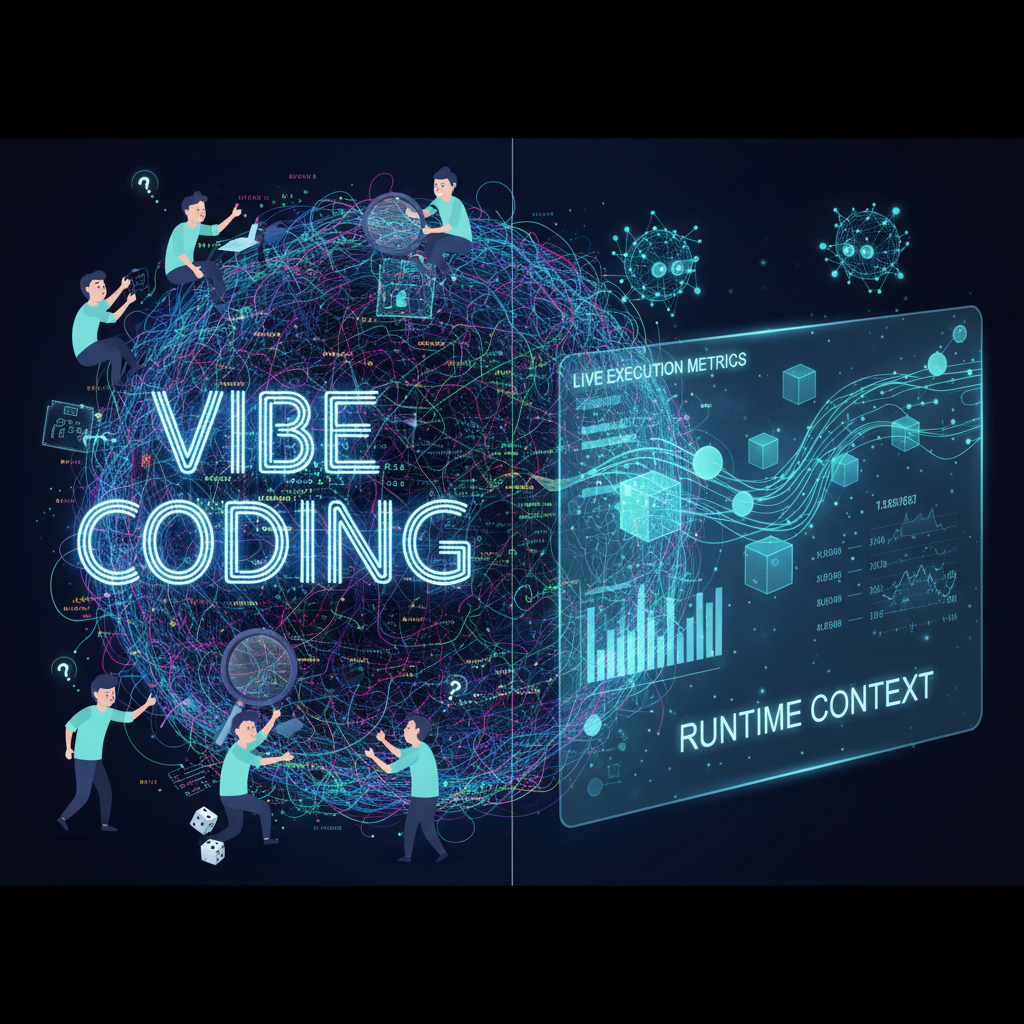
Runtime inspection bridges the gap between what an application was programmed to do and what it is actually doing. As detailed by Standard Beagle, runtime inspection allows tools to move from reasoning in theory to responding to what is actually happening in a live application.
By creating a bridge between live operations and language models, we eliminate the need to guess. A dedicated Mission Control Protocol (MCP) for production debugging and live evidence gathering acts as this bridge. It allows autonomous systems to query the exact state of variables, evaluate conditions, and read the active stack trace at the exact millisecond an anomaly occurs.
Establishing this runtime context for AI agents in SRE shifts the approach from reactionary to proactive. It creates a shared context layer where the human engineer and the autonomous helper are looking at the same indisputable facts. Providing runtime context to AI coding assistants for remediation is key here.
How Runtime Truth Transforms Remediation
Understanding the business value of this shift requires contrasting a static workflow against an evidence-based approach.
In a static workflow, an alert fires. The engineer copies the available generic log into a prompt window. The model generates three possible causes. The engineer picks the most logical one, codes a fix, initiates a thirty-minute deployment pipeline, and waits to see if the error counter drops. If it fails, the cycle repeats.
In a dynamic workflow, runtime telemetry changes the equation. An alert fires. An autonomous entity investigates the alert by dynamically inserting a probe into the failing function. It captures the local variables and application state for the next five failing requests.
It then analyzes this live data, pinpointing the exact malformed data structure. The model presents the SRE with an accurate code change alongside the captured payload as mathematical proof.
Experts agree this methodology is superior. An exploration on Medium emphasizes how feeding live application behavior into language models results in dramatically higher accuracy compared to parsing repositories alone.
Putting It to Work: The Dynamic Code Workflow
To make this practical, SRE teams use a Mission Control Protocol (MCP) architecture to connect their language models directly to dynamic instrumentation platforms. Lightrun operates as the ultimate IDE-native extension for this architecture, providing the precise mechanism needed to execute live evidence gathering.
With Lightrun, an action is not a permanent modification to the codebase. It is an ephemeral query placed on a running application. Let us revisit the earlier transaction failure, this time utilizing a Python service connected to Lightrun.
1# pip install lightrun
2import lightrun
3
4# Lightrun agent initialization enables secure remote control
5lightrun.enable(company="enterprise_corp", company_key="secure_key")
6
7def handle_gateway_request(request).
8    # Lightrun Snapshot: Capture request.headers and request.body when status == 500
9    # (This action would be placed via IDE plugin or CLI, not programmatically)
10
11    parsed_payload = extract_payload(request)
12
13    # Lightrun Dynamic Log: Log "Upstream latency for {request.id} is {latency}ms"
14    # (This action would be placed via IDE plugin or CLI, not programmatically)
15
16    result = external_gateway.process(parsed_payload)
17    return result
In this workflow, the problem is no longer a mystery. The LLM utilizes the Lightrun API to place a Snapshot directly on the extract_payload line. A Snapshot captures the complete variable state, call stack, and thread context without halting the execution of the application. The system immediately captures the fact that request.headers['Content-Type'] is unexpectedly returning text/plain instead of application/json.
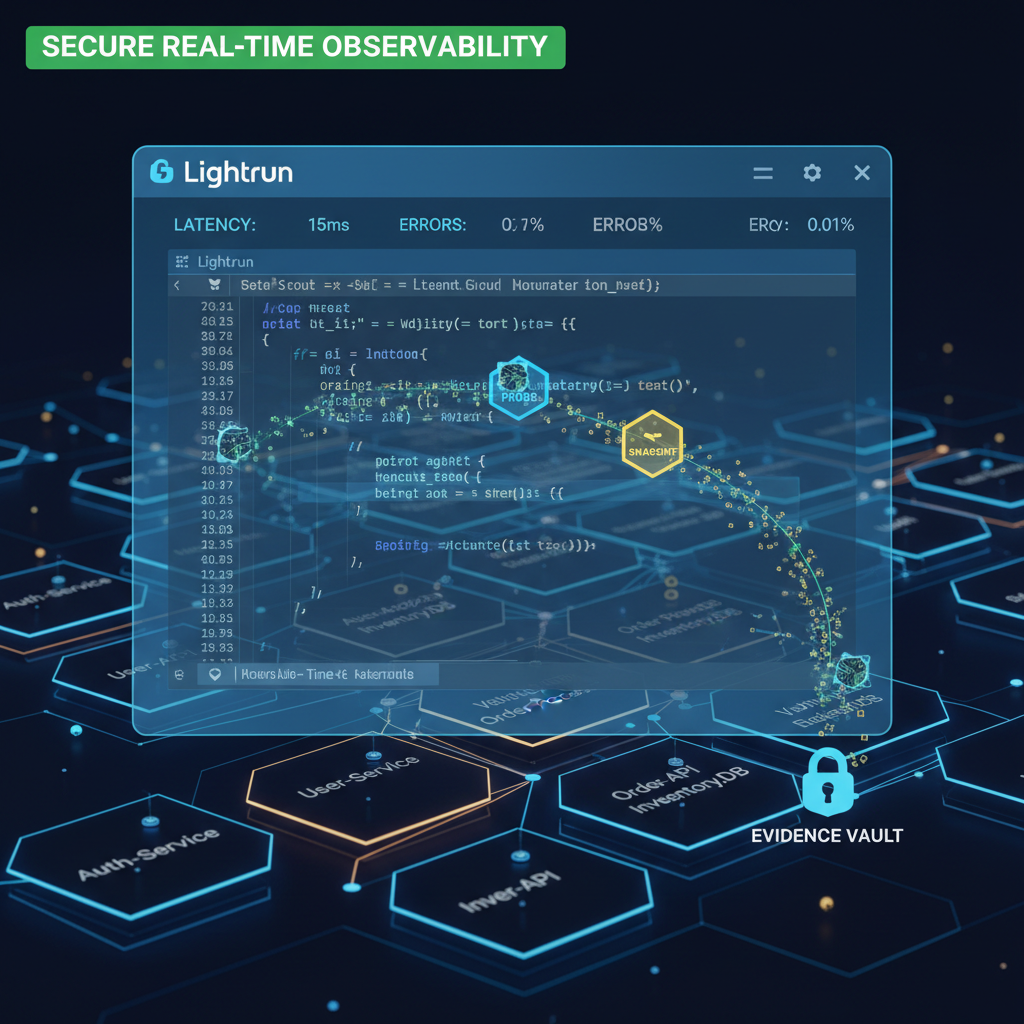
The machine does not have to guess. It has the direct evidence. It can now provide a verified patch to the engineer within their JetBrains or VS Code environment, reducing incident response from hours to minutes. This illustrates the value of providing runtime context to AI coding assistants for remediation.
Governing AI Access in Live Systems
The immediate objection from any veteran SRE revolves around security. Giving an automated algorithm the power to peer into a production database or modify variables in memory sounds like a recipe for a catastrophic breach. Implementing an MCP for production debugging in AI SRE must therefore be gated by extreme architectural constraints.
Safety cannot be an afterthought; it must be the foundational design principle. Lightrun addresses this through isolated Sandboxed Investigations. When an automated entity requests a Dynamic Log or Snapshot, that request is executed outside the main application thread.
First, this guarantees minimal performance degradation. The claim that the instrumentation fundamentally cannot alter the application's native state is unverified. Advanced instrumentation tools can perform automatic instrumentation without requiring code changes, suggesting their capability to modify or influence the application dynamically. This read-only enforcement mechanism means that even a language model cannot accidentally write malicious data to a production database or crash a critical Kubernetes pod.
Second, enterprise environments demand strict data privacy compliance. Relying on an algorithm to debug a payload means the algorithm might accidentally ingest a credit card number or a raw password. Lightrun mitigates this through automatic PII Redaction. Before any memory object or log string is transmitted back to the human or the language model, predefined blocklists scrub sensitive patterns at the agent level.
Combined with rigorous Role-Based Access Control (RBAC) and comprehensive audit trails, these governance protections ensure that site reliability teams can leverage the speed of autonomous investigation without compromising internal compliance standards.
The Future of Self-Healing Operations
We have reached the upper limit of what static abstraction can deliver for operational stability. Writing more boilerplate files faster does not make a system more reliable. True reliability requires an intimate, immediate understanding of how applications behave under duress.
The industry is rapidly moving toward the concept of an AI SRE—a system capable of autonomous software remediation grounded strictly in operational reality. As SiliconAngle reports, utilizing live telemetry allows organizations to bypass the tedious manual triage phases of incident management entirely.
Providing runtime context to AI coding assistants for remediation is no longer an experimental luxury; it is a structural necessity for modern enterprise engineering. When we replace assumed logic with observable proof, we empower our teams to investigate safely, validate confidently, and restore services instantly. SREs no longer have to settle for plausible guesses. They can finally demand the truth.
To explore how your team can establish a live evidence layer for autonomous investigations and secure production debugging, visit Lightrun to see dynamic observability in action.