
Key Takeaways
- 1Embrace runtime-aware metrics and patterns to move beyond guesswork in software development.
- 2Understand the limitations of localhost development and the importance of live execution evidence.
- 3Implement patterns such as distributed tracing, feature flags, and real-time monitoring for better debugging and reliability.
- 4Key patterns include centralized logging, health checks, and canary releases for enhanced observability.
- 5Shift to a data-driven approach for application development and deployment with confidence.
The most frustrating scenario in software engineering often begins with a single, unhelpful phrase: "It works on my machine." Engineers stare at local source code, running synthetic tests against mocked databases, while the actual anomaly evades capture in the live cluster. This discrepancy between local assumptions and live reality is the root cause of prolonged incident response times and exhausting debugging sessions.
When an intermittent bug cannot be reproduced locally, teams typically resort to guesswork. They theorize what might be going wrong, write new log statements, commit the code, wait for the continuous integration and continuous deployment pipeline to finish, and observe the results. If the guess was wrong, the cycle repeats. This back-and-forth drains engineering velocity and pollutes the codebase with noisy, permanent logging that exists solely to catch one fleeting edge case.
To solve this, engineering organizations are moving away from fixed dashboards and preemptive logging. They are adopting flexible concepts like runtime-aware development metrics and patterns to observe code exactly where it executes. Instead of treating telemetry as a post-deployment afterthought managed entirely by operations teams, developers can now retrieve live execution evidence directly from their editors. This shifts the debugging paradigm from symptom analysis to systemic verification.
1. Inspecting Ephemeral State Without Pausing Execution
Before looking at solutions, we must define the core limitation of standard local debugging tools. A traditional debugger works by halting the entire application thread when it hits a breakpoint. This allows the developer to inspect memory, variables, and the call stack at their own pace.
The Traditional Constraint
While thread-pausing debuggers are invaluable on localized machines, they are fundamentally incompatible with live systems. Halting a thread in a running microservice causes network timeouts, health check failures, and cascading service degradation. Consequently, engineers are historically barred from inspecting exact variable states in live, customer-facing environments.
The Dynamic Approach
The modern alternative replaces invasive thread pausing with non-disruptive state capture. By utilizing an IDE Plugin to place virtual markers in the code, engineers can extract the exact parameters flowing through a function at a specific millisecond. What we call Snapshots capture the stack trace and local variables on demand without interrupting the application flow. This safe Runtime Instrumentation executes in an isolated sandbox, ensuring minimal overhead and negligible impact in benchmarks to the running service.
1# pip install lightrun
2import lightrun
3# Agent Initialization
4lightrun.enable(company="<company>", company_key="<key>")
5
6def process_webhook_payload(payload).
7    user_id = payload.get("user", {}).get("id")
8    event_type = payload.get("type", "unknown")
9
10    # The Lightrun Snapshot placed here via IDE captures 'payload' contents and 'user_id' exactly when event_type == 'payment_failed'
11    # The application thread is never paused.
12
13    if event_type == 'payment_failed'.
14        handle_failure(user_id, payload)
15
16    return {"status": "processed", "id": user_id}
2. Replacing Trial-and-Error Logging with On-Demand Telemetry
Predefined logging is essentially an exercise in prediction. Engineers must anticipate exactly what information will be necessary during a future, unknown incident. They write static log statements describing successful transactions and anticipated error paths.
The Problem with Static Predictions
When an unexpected failure mode emerges, the pre-written logs are almost never sufficient. The missing log statement forces teams into a time-consuming redeployment cycle just to add basic visibility. Furthermore, tracking general software metrics is beneficial for overall health, as noted in discussions around baseline software development metrics, but high-level metrics do not provide the granular application context required to fix a specific null pointer exception.
Generating Telemetry on the Fly
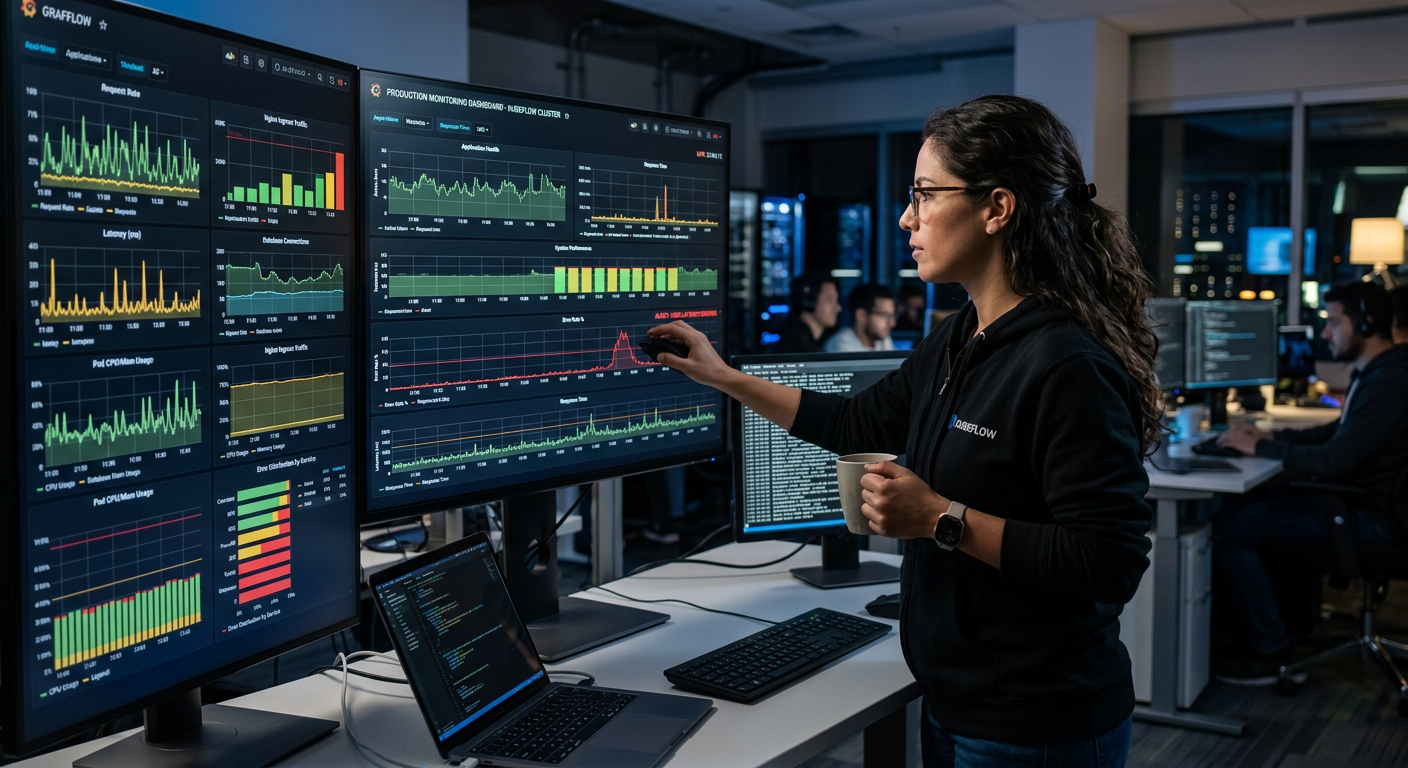
Applying runtime-aware development metrics and patterns allows teams to bypass the redeployment cycle entirely. Instead of guessing, developers inject Dynamic Logs directly into running code. These logs execute as if they were natively compiled, capturing necessary context for only as long as the developer needs them.
1// Maven dependency: com.lightrun:lightrun-agent
2// Agent attach applied via JVM args: -agentpath:/path/to/lightrun_agent.so
3
4public Order processOrder(Order order) {
5    validateInventory(order);
6
7    // The Lightrun Dynamic Log placed here via IDE captures: "Processing order {order.getId()} with status {order.getStatus()} at tax rate {calculateTax(order)}"
8    // This log is added in real-time, instantly visible in the IDE terminal, with no redeploy required.
9
10    paymentGateway.charge(order.getAccountId(), order.getTotal());
11    return orderRepository.save(order);
12}
3. Isolating Bottlenecks with Dynamic Metrics
Application performance monitoring tools are excellent at showing symptoms. A dashboard will display a spike in CPU usage or an increase in endpoint latency. However, bridging the gap between that macro-level dashboard spike and the specific line of inefficient code requires extensive manual profiling.
The Limitations of Aggregate Monitoring
Performance bottlenecks often hide inside looping constructs, unoptimized database queries, or inefficient serialization methods. Traditional metrics provide the "what" and the "when", but they rarely provide the "where". Implementing comprehensive profiling across an entire application creates severe performance degradation, which is why detailed profiling is typically reserved for localized load testing rather than live traffic.
In-IDE Profiling
To identify performance hotspots accurately, engineers require IDE-native observability for real-time performance profiling. By inserting virtual counters and timers at the method level, developers generate Dynamic Metrics on demand. For example, if a specific service is approaching total capacity, engineers can define custom metrics around internal queue sizes. Monitoring these saturation metrics gives immediate visibility into system limits right where the code is written, confirming exactly which function is responsible for the slowdown.
4. Bridging the Microservices Chasm with IDE-Assisted Tracing
Modern architectures are highly distributed. A single user interaction might traverse an API gateway, an authentication service, a message broker, and multiple backend databases.
The Disconnected Trace
When a request fails in a distributed architecture, finding the failure point is agonizing. Distributed tracing systems aggregate flow data, but navigating these external dashboards pulls the developer out of their workflow. The engineer must manually map the dashboard's service graphic back to the underlying repository and file structure. This context switching breaks concentration and drastically increases the mean time to resolution.
Following the Data Flow
Developers perform best when they do not have to leave their primary workspace. By utilizing Dynamic Traces natively within the editor, teams link distributed spans directly to the source code. This integration means an engineer can click on a failed trace span in their editor pane and immediately jump to the exact file and line number that threw the exception. It unifies the macro view of the architecture with the micro view of the application logic.
5. Grounding AI Assistants in Live Execution Context
Generative AI agents drastically accelerate code creation and refactoring. However, AI cannot reason about a system it cannot see. Traditional coding assistants rely entirely on static analysis, reading syntax and structural patterns to suggest fixes.

The Hallucination of Static Agents
When asked to debug a complex architectural bug, an AI tool restricted to static source code will often hallucinate. It makes assumptions about database states, network latency, and payload structures that are factually incorrect in the deployed environment. AI cannot self-correct without access to real-time feedback loops.
The Rise of the AI SRE
To make autonomous remediation reliable, AI agents must be integrated with live system states. As highlighted in research surrounding the Model Context Protocol, platforms must unify prompt engineering with live metrics and evaluations. An AI SRE platform uses MCP to feed real Runtime Context directly to the language model. When an AI agent proposes a fix, it can verify its own hypothesis by requesting dynamic telemetry from the running application. Trusting AI to resolve incidents is viable when the agent acts upon verifiable execution evidence.
6. Securing Observability with Zero-Trust Guardrails
Access to live application memory is inherently risky. Standard debugging practices expose entire object graphs, including passwords, personal identification numbers, and financial details.
The Security Versus Velocity Dilemma
In highly regulated industries, organizations often ban developers from accessing live systems altogether out of fear of data breaches. This hardline stance protects customer data but devastates engineering velocity. When developers cannot see the system, support tickets pile up, and SRE teams act as a strained middleman endlessly transferring log exports to the engineering department.
Implementing Enterprise Safeguards
The final pattern applies rigorous governance to real-time observability. Platforms must employ automatic PII Redaction to obfuscate sensitive strings before they ever leave the host machine. Coupled with strict RBAC mechanisms and complete audit trails, organizations give developers the visibility they need without compromising compliance. An engineer can inspect a payment processing object, but the credit card number is permanently masked at the agent level. This balances the implementation of runtime-aware development metrics and patterns with uncompromising data security.
Escaping the Guesswork Trap
The reliance on static code analysis and preemptive logging forces engineers into a reactive, slow methodology. When local machines fail to replicate live anomalies, the resulting guesswork degrades software quality and frustrates development teams.
Bridging this gap requires moving beyond static dashboarding. By embracing dynamic, on-demand telemetry securely retrieved without thread pausing, teams eliminate deployment friction. Providing both human engineers and AI agents with direct access to live execution evidence transforms debugging from an exercise in prediction to an exercise in verification. Ultimately, observing code where it actually runs is the only way to build inherently self-healing, reliable software.