
Key Takeaways
- 1Transient, hard-to-trigger faults, known as "Mandelbugs," are increasingly common in complex, AI-generated codebases.
- 2Traditional troubleshooting methods like guesswork-based logging and forced re-enactment are inefficient and introduce friction in modern distributed systems.
- 3Dynamic tracing allows engineers to instrument running code safely, extract telemetry without altering source code, or restarting applications.
- 4Lightrun enables dynamic tracing for non-reproducible production bugs by allowing engineers to place non-breaking data extraction points directly from their IDE.
- 5Dynamic tracing significantly reduces Mean Time to Resolution (MTTR), has minimal production impact, lowers developer toil, and provides high-quality evidence.
- 6Automated postmortems with AI agents require high-fidelity telemetry from dynamic instrumentation platforms like Lightrun via protocols such as MCP.
An alert triggers at three in the morning. A critical production service is experiencing elevated error rates, but your performance dashboards show normal CPU metrics, and your application logs reveal nothing unusual. By the time an engineer logs in to investigate, the error spike has vanished entirely. Customer support tickets confirm the incident was real, but without a predictable way to trigger the failure, the engineering team is left chasing a ghost.
These transient, hard-to-trigger faults are known in academic literature as "Mandelbugs", and they are difficult to resolve. According to researchers analyzing the past, present, and future of bug tracking, the complexity of these elusive errors renders traditional fixing processes difficult. Software systems are increasingly built as distributed webs of microservices, serverless functions, and third-party APIs. Attempting to isolate a vanishing anomaly within this architecture feels less like software engineering and more like digital forensics.
The frequency of these elusive issues is accelerating due to the adoption of generative AI in software development. As reported by The New York Times, AI development tools can increase a team's code output from 25,000 lines per month to 250,000 lines. This massive expansion in code volume creates an unprecedented review backlog. It dramatically increases the likelihood of subtle edge cases slipping into live environments. With millions of new lines compiled and shipped, relying on legacy troubleshooting methodologies is no longer a viable operational strategy.
Defining the Non-Reproducible Incident
Before evaluating different troubleshooting methodologies, it is necessary to define what makes a bug non-reproducible. A non-reproducible bug is a defect that occurs in a live environment but cannot be reliably triggered on demand by a developer in a local or staging environment.
These issues typically stem from highly specific state combinations. A race condition might only occur under specific memory loads. A database deadlock might only happen when a specific background job aligns perfectly with a user query. Because the exact state of the production environment is constantly shifting, the conditions that caused the error disappear almost immediately. To solve these mysteries, engineers need evidence from the exact moment the failure occurred.
Old Forensics: The Failing Playbook for Finding Fleeting Bugs
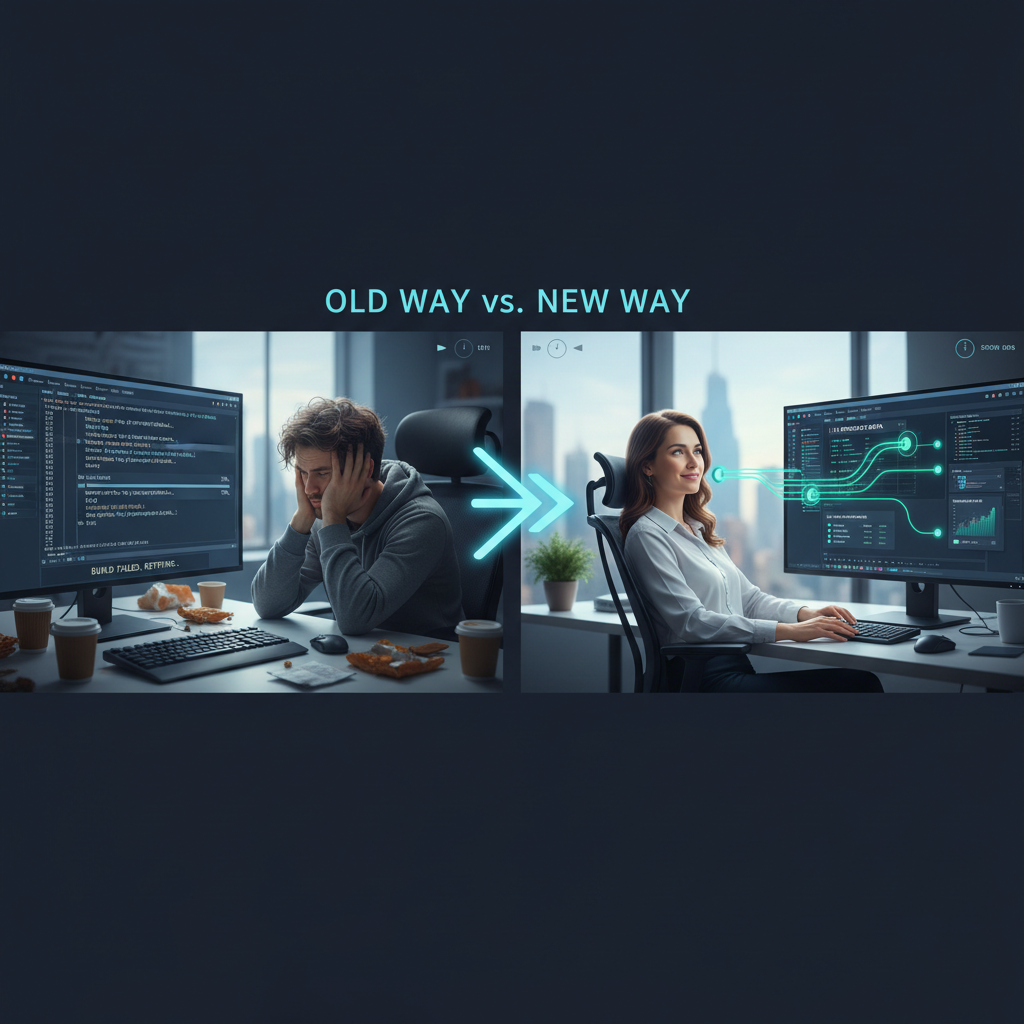
Historically, engineering teams have relied on two primary methodologies to extract evidence and diagnose non-reproducible issues. While these methods were standard practice for monolithic applications, they introduce high friction when applied to highly distributed, AI-generated codebases.
Method 1: Guesswork-Based Logging
Guesswork-based logging is the practice of reacting to an incident by adding speculative log statements to the codebase, testing the code, and redeploying the application. The goal is to capture the missing variable state the next time the anomaly occurs.
This approach forces engineers to guess where the problem might be originating. The developer adds logger.info() or console.log() statements to functions they suspect are failing. They commit the code, push it through the CI/CD pipeline, and wait for the deployment to finish.
When using traditional development workflows, logging code is added directly into the file. Then, a new build is deployed and run through the CI/CD pipeline. __CODE_BLOCK_0__
The fundamental flaw in guesswork logging is its reliance on iteration through redeployment. Every time an engineer guesses wrong, they must write more logs and initiate another lengthy redeployment cycle. This process pollutes the codebase with permanent debug logs that increase storage costs. Furthermore, manual toil of this nature consumes valuable engineering time and prevents teams from solving root causes efficiently, a widespread issue noted in analyses of site reliability engineering practices.

Method 2: Forced Re-enactment
Forced re-enactment is the attempt to recreate the exact production environment and user state on a secure local machine or a dedicated staging cluster. Engineers try to mirror the databases, duplicate the traffic patterns, and simulate the exact inputs that led to the crash.
This methodology exists because local debugging allows engineers to use standard IDE debuggers. They can pause execution, inspect memory heaps, and step through the code line by line.
However, modern production environments cannot be easily simulated. Downstream dependencies, third-party API rate limits, and live network latency are nearly impossible to replicate perfectly. Staging environments rarely contain the exact data permutations found in production due to privacy restrictions and scale constraints. When dealing with transient bugs, a developer can spend weeks attempting to force a re-enactment, only to conclude that it simply "works on my machine."
Modern Forensics: Dynamic Tracing as a Live Interrogation Tool
Instead of guessing where to put logs or attempting to rebuild the entire environment locally, modern reliability engineering utilizes dynamic tracing. Dynamic tracing is a technique that allows engineers to safely instrument running code and extract telemetry data without pausing the application, altering the source code, or requiring a restart.
Implementing dynamic tracing for non-reproducible production bugs transforms the entire troubleshooting workflow. It allows engineers to interact with a live system as if it were a database. You can query the live architecture, asking it for the specific state of a variable within a specific function, precisely when a specific condition is met.
Pioneers in this field have shown that this capability acts as a direct conversation with the operating system and application layers. Adopting this philosophy can compress troubleshooting operations from days or weeks down to a matter of hours, according to experts discussing why dynamic tracing is the future of production troubleshooting.
The Interrogation in Action: Safely Debugging a Live API Gateway
To ground this concept in reality, consider the challenge of debugging production API gateway security configuration errors. A misconfigured JSON Web Token (JWT) validation rule on an API gateway might occasionally reject valid user requests, but only under specific load balancer routing conditions.
Using traditional methods, solving this would require taking the gateway offline to deploy new diagnostic logs, potentially disrupting thousands of active user sessions.
Instead, an engineer can use dynamic tracing for non-reproducible production bugs via Lightrun. From within their native IDE Plugin, the engineer can place a non-breaking data extraction point directly on the live routing function.
The following code illustrates an API gateway function. The inline comments show where Lightrun non-breaking points dynamically inject instrumentation without altering the source code. __CODE_BLOCK_1__
In this scenario, Lightrun uses Runtime Instrumentation to insert operations directly into the Node.js application memory at runtime. The developer adds Snapshots to capture the exact state of req.ip and rawToken, but only when the path matches the problematic admin route. They also place Dynamic Logs to print specific variables to the existing log stream.
Because Lightrun execution operates within an isolated sandbox, the main thread is never paused. The application continues serving traffic with minimal overhead. Furthermore, enterprise platforms require strict security guardrails. Lightrun enforces PII Redaction automatically, ensuring that sensitive token payloads or user identifiers captured by Dynamic Telemetry are masked before they ever leave the production boundary.
Choosing Your Forensic Toolkit: A Comparative Summary
Understanding the practical differences between these three methodologies helps engineering leaders determine the appropriate strategy for their teams. Adopting dynamic tracing for non-reproducible production bugs offers distinct advantages across multiple operational vectors.
Speed and Mean Time to Resolution (MTTR)
- Guesswork Logging: Very slow. MTTR is heavily dependent on CI/CD pipeline speed and the luck of guessing the right variable to log on the first try.
- Forced Re-enactment: Highly variable. Setup time for data replication often takes days, leading to extended incident lifecycles.
- Dynamic Tracing: Near-instantaneous. Because data is requested from live applications, verification happens as soon as the relevant code path executes again, drastically reducing investigation timelines.
Production Impact
- Guesswork Logging: High friction. Requires full service redeployments, which introduces operational risk and can disrupt active user sessions during the rollout.
- Forced Re-enactment: Zero production risk, as all work happens in isolated environments.
- Dynamic Tracing: Minimal impact. Tools built around a sandboxed architecture verify instrumentation safety before injection, preventing memory leaks or application degradation while the service remains live.
Developer Toil and Effort
- Guesswork Logging: High toil. Engineers must constantly switch contexts between writing code, monitoring deployment pipelines, and analyzing log aggregation dashboards.
- Forced Re-enactment: Extreme toil. Configuring mock services, anonymizing database backups, and simulating network conditions is a massive drain on engineering resources.
- Dynamic Tracing: Low friction. Developers request Runtime Context directly from their IDE, retrieving answers seamlessly within their standard coding environment.
Quality of Evidence
- Guesswork Logging: Often incomplete. Because developers are guessing, they frequently capture the wrong variables or fail to capture the nested object states necessary for full context.
- Forced Re-enactment: Misleading. Incomplete simulations often lead to false positives, forcing teams to solve imaginary bugs that do not actually exist in production.
- Dynamic Tracing: Absolute truth. Extracting Dynamic Traces from the live process guarantees the captured state is the exact condition causing the operational failure.
The Future of Postmortems is Automated
As organizational complexity scales, the responsibility for maintaining uptime is shifting toward automated systems and AI-assisted workflows. However, large language models cannot accurately diagnose runtime failures if their only context comes from static source code and generic error strings.
To build an automated security workflow for production debugging without redeploy, AI agents require high-fidelity telemetry. Through protocols like the Model Context Protocol (MCP), AI SRE agents can interface with dynamic instrumentation platforms. When an anomaly is detected, the agent can autonomously insert a data extraction point, evaluate the live variable state, and formulate a remediation plan based on actual execution evidence.
This directly solves the challenge of how to perform postmortem analysis without service redeployment. Instead of an incident review concluding with an action item to "add more logging next sprint," the necessary context is gathered on-demand during the incident itself. The system heals faster, the engineers avoid unnecessary toil, and the root cause is identified with precision.
Relying on legacy methodologies for modern cloud architectures is a guaranteed path to operational burnout. By equipping teams with dynamic tracing for non-reproducible production bugs, organizations replace the guesswork of traditional debugging with verifiable, live evidence. The transition away from static telemetry and toward on-demand runtime insight is the definitive next step for reliability engineering.
See how Lightrun provides runtime context on your stack: lightrun.com/platform